

Richard Feynman

Can you explain it?

Image c/o Søren Lybecker ©

One of the most effective ways to deepen your understanding is surprisingly simple. Rather than asking yourself whether you can remember something, ask whether you can explain it. The Feynman Technique, named after physicist Richard Feynman, encourages us to explain a concept as though we were teaching it to a 12-year-old. The moment our explanation becomes unclear or overly complicated, we have identified the limits of our own understanding.

Instead of memorising more information, return to the source material only where your explanation breaks down. Then repeat the process until the idea can be explained clearly and simply. I think as leaders, we often mistake complexity for expertise, in reality, simplicity is not the absence of depth; it is evidence that we have mastered it. If you cannot explain an idea clearly, perhaps the next step is not to speak more, but to learn more. What do you think?
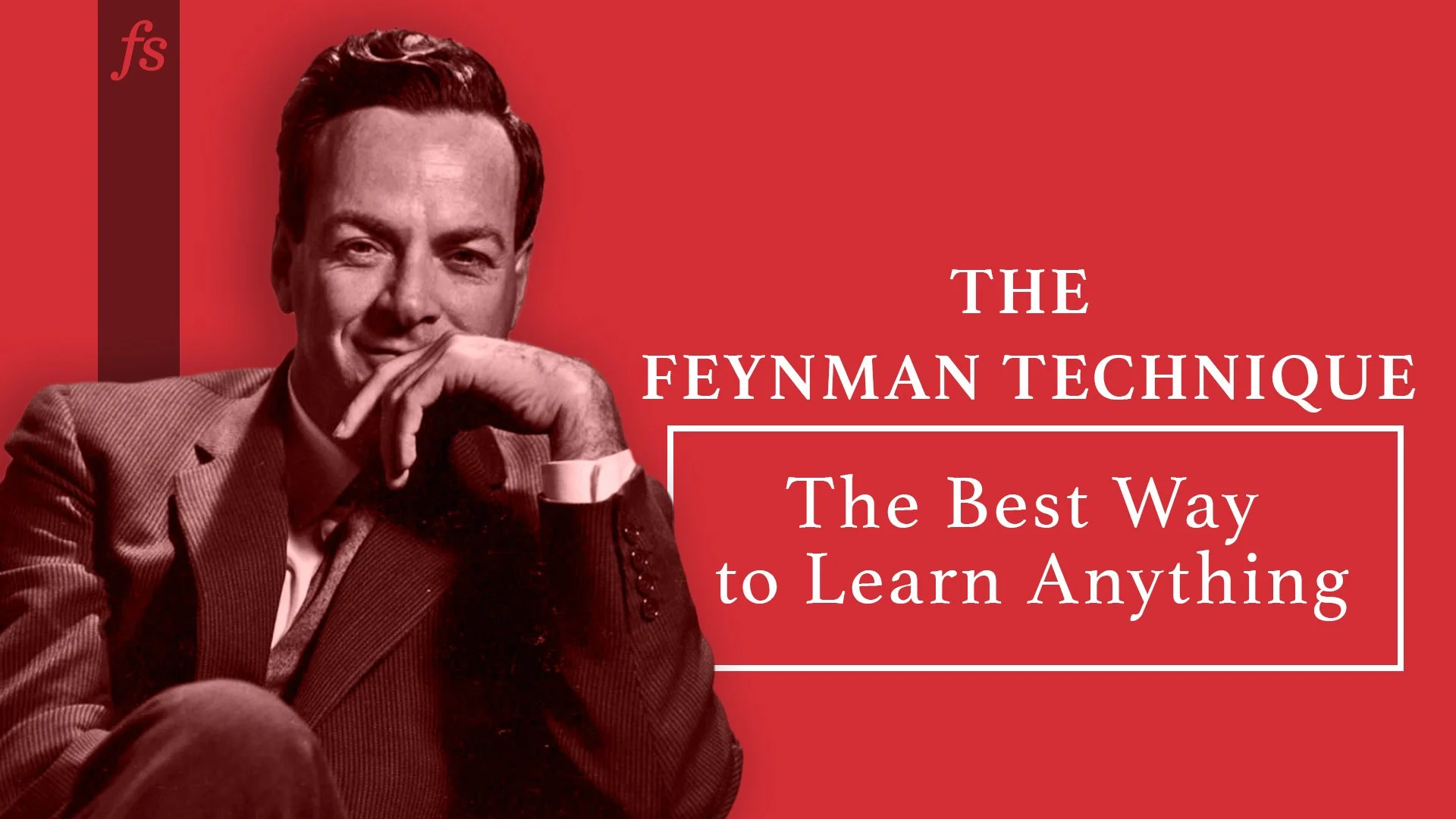

The Feynman technique

Mastery begins with the ability to explain a concept clearly. To use the Feynman Technique, take any idea and attempt to articulate it as if teaching it to a child. The point at which the explanation breaks down is the point at which understanding is incomplete, and these are the areas that require further study. Return to the source material with precision, then test the explanation again. I think true understanding is demonstrated when you can explain complex concepts with simplicity, showing that you have fully grasped them.


Let it go

Leaders can become so focused on proving how smart or right they are that they lose sight of their purpose: to make a meaningful difference. Before speaking, pause and ask yourself: “Am I willing, at this moment, to invest the energy required to create a positive impact on this issue?”
I think that If the answer is yes, speak with intention. If the answer is no, choose to let it go.

“Never confuse education with intelligence. Intelligence isn’t ability to remember and repeat, like they teach in school. Intelligence is ability to learn from experience, solve problems, and use our knowledge to adapt to new situations.”
— Richard Feynman

Develop your skills

Investing in coaching is one of the best investments you can make if you are a leader, manager, or aspire to become one. How much time do you spend coaching your direct reports?

Here are 10 essential coaching skills to develop:
1. Empathy – Put yourself in their shoes.
2. Self-management – The ability to regulate your own emotions and behaviour.
3. Building trust – The foundation of all relationships.
4. Observational skills – Accurately reading situations and people.
5. Planning – Increasing the likelihood of reaching goals.
6. Active listening – A core skill for effective coaching.
7. Communication skills – Explaining clearly and holding others accountable.
8. Encouragement and praise – Reinforcing effort and growth.
9. Honest, useful feedback – Delivered constructively to drive improvement.
10. Analytical and problem-solving skills – Supporting others to find solutions.


Better questions

Good sales questions are measured by the level of curiosity they spark in your buyer. Buyers will create a budget where none exists when there’s a meaningful-enough problem, that’s worth solving.

  • Why do they need it?

  • How is it different?

  • Why is it better?

  • What happens if they don’t get it?

Knowledge is having the right answers. Intelligence is asking the right questions. Wisdom is knowing when to ask the right questions.
— Professor Richard Feynman

Being aware and open to change

Your brain tells you that you are safe with people who look, think and act similar, this is one of our many and various unconscious biases. These learned stereotypes are very powerful as they are so deeply ingrained into our persona, for example, the biases we all hold around race, religion, gender, power, and privilege structures. Playing on our unconscious biases and fears is the bread and butter of both political and marketing campaigns. In order to ‘judge’ without undue fear, you need to look at your own biases and the fears that sit under them. I think we can overcome our unconscious biases by becoming aware and being open to change.

Life is too short to worry about stupid things. Have fun. Fall in love. Regret nothing and do not let people bring you down. Study, think, create and grow. Teach yourself and teach others.
— Professor Richard Feynman

Yesterday morning, I asked a woman if she needed help in carrying her pram (a four-wheeled baby carriage) down the stairs – I have to admit that I would not have asked a man if he were in the same position. I know that my actions were not a problem, they were courteous and friendly but underneath I may have unexamined bias about the difference in roles and capabilities of men and women. Contact me via e-mail and let me know how you deal with your implicit biases.


The chess endgame

One reason I love coaching is you are forced to take a holistic view. Coaches are generalists, who have to obtain a near specialists’ knowledge about a lot of things, for example, from behavioural psychology to political trends. We have to know a little bit about many things and then we must understand how they interact with the methods we are trying to install.

The chessboard metaphor is common throughout therapy to help develop the distinction between an observing self and avoided psychological content. I think that sometimes a well-placed pawn is more powerful than a king.

Knowledge is having the right answers.
Intelligence is asking the right questions.
Wisdom is knowing when to ask the right questions.
— Professor Richard Feynman

What goes up must come down

Knowledge is having the right answers. Intelligence is asking the right questions. Wisdom is knowing when to ask the right questions.
— Professor Richard Feynman

The power of mystery

Do not use your energy to worry. Use your energy to believe, to create, to learn, to think and to grow.
— Professor Richard Feynman

One of the greatest physicists of the last century

Richard-Feynman.jpg
Never confuse education with intelligence. Intelligence isn’t the ability to remember and repeat, like they teach you in school.
Intelligence is the ability to learn from experience, solve problems and use our knowledge to adapt to new situations. - Professor Richard Feynman