
personal development

The 20 hour rule

One of the biggest barriers to learning a new skill is believing it will take years before we become competent. Author Josh Kaufman challenges this assumption through what he calls the 20-Hour Rule. While it may take thousands of hours to achieve world-class expertise, it takes far less time to become capable and functional. Around twenty hours of focused, deliberate practice is often enough to develop a solid foundation in a new skill.

I think many people never begin because they focus on the size of the mountain rather than the next step in front of them. Whether it is coaching, public speaking, strategic thinking, or learning a new language, progress begins with the willingness to start. Do not let the pursuit of mastery prevent you from becoming competent. Remember the first twenty hours often make all the difference.

Book: “The First 20 Hours: How to Learn Anything ... Fast” - Josh Kaufman


Calmness of mind

c/o Vivi An

A calm spirit is intentional about where it invests its energy, attention, and care. These resources are finite, and over time we learn that not everything deserves equal access to them. I think calmness teaches us to let go with grace, as it reminds us that endings do not diminish our worth, and that rejection is not a measure of our value. Whether someone chooses us or overlooks us does not change who we are.

In fact true self-worth comes from something deeper. It is reflected in our integrity, our character, and the way we treat others when no one is watching. It is found in our ability to rise after disappointment, learn from experience, and continue growing despite setbacks. Life will always bring moments of uncertainty, loss, and change. The challenge is not to avoid them, but to remain grounded through them. When we do, we discover that our value was never dependent on external validation, it was within us all the time.


Nobody can be you but you

How would you like people to describe you when you are not in the room?

Many of the most significant decisions that shape your career are made when you are not present. Decisions relating to compensation, promotion opportunities, high-profile assignments, and leadership potential are often discussed and determined in rooms where you do not have a seat at the table. Therefore, I think the question should be: What do people say about you when you are not there to speak for yourself?

Choose three adjectives that you would want others to use when describing you in your absence. Identifying the three qualities you want to be known for helps you build a deliberate professional reputation and ensures your actions consistently reinforce the perception you want others to have of you.


Pick your metrics carefully

When was the last time you conducted an honest audit of yourself?

Are you investing too much of your time and energy into what is easy to measure, rather than what truly matters? If so, you may be overlooking some of the most meaningful aspects of both your personal and professional life. The challenge is that the most valuable outcomes are often the hardest to quantify, for example, trust, judgment, relationships, and long-term impact.

“What gets measured gets managed” is only part of the equation. Without the right metrics, you risk managing what is visible rather than what is important. I think effective leadership requires a broader lens, one that balances measurable performance with less tangible, and equally critical, indicators of success.


Raising self-awareness

Do you have the discipline to focus on what you can control?

Your attitude, your actions, and your effort are within your control. There will be moments when life tests your patience, when you are working hard and seeing little reward. I think it’s important to remember that seeds planted in good soil do not grow overnight. Progress is often happening beneath the surface, long before it becomes visible. Where are you trusting the process right now?


Confirmation bias

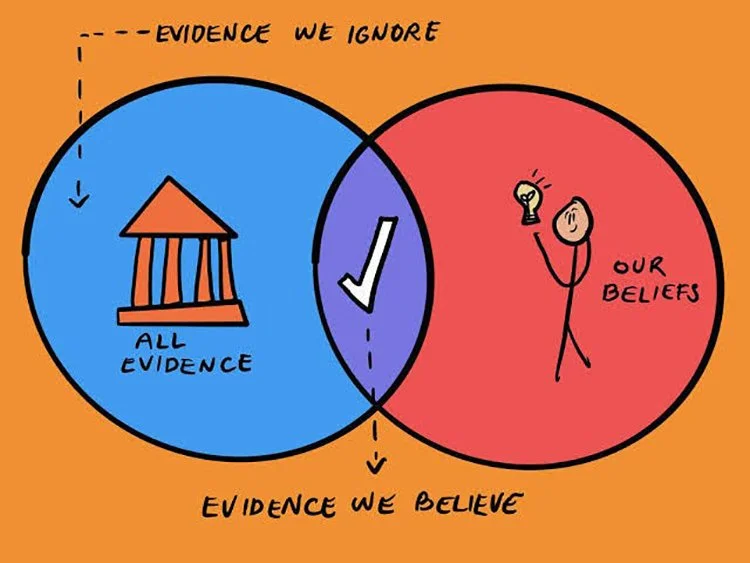
We all form early impressions about people and situations. The question is not whether we do it, but how aware we are of what follows. Once that first impression is in place, we tend to notice the information that confirms it, while overlooking what challenges it. This pattern, known as confirmation bias, can quietly shape how we listen, interpret, and respond to others.

Questions:

  • What assumptions did I make in this moment?

  • What might I be missing?

  • How would my perspective shift if I actively looked for disconfirming evidence?

I think in order to create a more inclusive workplace usually starts with slowing down these automatic patterns and choosing curiosity over certainty. What do you think?


You do not grow in comfort

Growth rarely happens in moments of ease. You are going to be broken, all your possessions are going to be stripped away - your comfort, your pride, your plans - until all what’s left is real. These moments may feel like setbacks, yet they often serve as powerful training grounds for personal development. I think painful moments, disappointments, and setbacks can become catalysts for growth when we choose to learn from them. Over time, these experiences shape us. Piece by piece, they strengthen our character, deepen our understanding, and prepare us to carry greater responsibility and purpose.


Clarify the issue

If you made a mistake, apologise.
If you are grateful, show it.
If you miss someone, connect with them.
If you are stuck, ask for help.
If you learn something new, teach it.
If you love someone, tell them, now.
If you are building a better future, invite others to join you.

“The most meaningful way to succeed is to help others succeed.”
— Adam Grant

The time is now

Stop comparing your behind-the-scenes to everyone else’s highlight reel. What you see is their success, not their struggle. Their wins, not their failures. The final draft, not the rough attempts that came before it. Your journey is yours, shaped by your timing, your context, and your work. Their journey belongs to them. Comparison drains joy and quietly undermines progress, pulling focus away from what actually matters: staying committed to your own path.


What comes naturally?

Change does not happen through logic alone. You cannot think your way out of a feeling, but you can feel your way into new patterns of thought. Emotions that are not processed remain stored in the nervous system, influencing behaviour beneath conscious awareness. I think much of what we do is automatic, driven by predictions based on past experiences. When you change the inputs, you change what the brain expects, and in doing so, you expand what becomes possible.


Vary your behaviour

I could live in any time, in any country, or on any planet and still be fine, because the inner reality creates the outer form. When your inner world aligns with your thoughts, beliefs, and self-concept, you stop reacting to life and start shaping it. The universe does not care what year you are in, what country you live in, or what chaos surrounds you, because you are the constant, and your energy is the constant. The universe bears no ill to me, and I bear no ill to it. That is inner peace and alignment. When you stop resisting and start receiving, energy responds accordingly. If your reality feels out of sync, the work is not outward but inward, recalibrating there is how you take your power back.


A deeper dive into self

Sometimes the questions are more important than the answers as they keep curiosity alive. It is difficult to know what you want when you have never had the space to understand who you are. Many people grow up in environments where self-discovery is limited. Others spend years in survival mode, moving through life without the time or safety to ask themselves deeper questions.

A simple place to begin is to take five minutes each day to reflect and ask yourself: What did I enjoy about today? What felt good? Why did it matter to me? Name the experience, explore it, and go into detail. Small daily reflections like this begin to form the building blocks of self-awareness. I think with time, those blocks become the foundation for clarity, confidence, and intentional action.


Step into your power

Are you afraid of making a mistake?

The status quo often sounds like: “This is the way we’ve always done it, so we have to keep doing it this way.” At its core, this is really about the fear of failure, the fear of having to admit that something didn’t work. Many of us carry a quiet voice that whispers, “You’re a fraud,” but shame is the real creativity killer. When shame and resistance join forces, progress stalls. The key isn’t to fight them, it’s to acknowledge them and use them as your compass. I think when resistance shows up, I know I’m on the right path as that tension tells me I’m about to grow. So, instead of running from it, I lean in because that’s where the magic happens.


Grounded presence

My calm energy speaks before I do. I don’t need to prove my worth, chase attention, or be unsettled by rejection. For me, it’s about showing up consistently, even when it isn’t exciting. It’s about thinking long-term and refusing to be shaken by every passing storm. That’s why I choose peace over drama and distance myself from people trapped in cycles of chaos or addiction.


Feet are made for walking

A person who is truly comfortable being alone is powerful.
If you disrespect them, they will walk away.
If you overstep their boundaries, they will cut you off.
If you try to manipulate them or threaten to leave, they will gladly hold the door open. Why?
I think it’s because they don’t need you in their life, they choose to let you be in it, and that is what makes them so dangerous.


Deeper understanding

The most difficult thing I have ever done was to believe that I could do it. When you don’t know what’s impacting you as when something is holding you down without your awareness it’s hard to break free. Living in a dominant culture designed to destroy your sense of self and your belief in yourself means you have had to learn how to connect with the power within you to handle where you are. The key is to be in a perpetual process of discovering the truth of who you are, while constantly fighting to escape the inner conversation that keeps you small.

“Always do what you are afraid to do.”
— Ralph Waldo Emerson