Throwback Thursday

Toffler1.jpg

I think that it’s important to look back in order to understand the present. Alvin Toffler’s prophetic 1970 book, “Future Shock” predicted how people and institutions of the late 20th century would contend with the immense strains and soaring opportunities of accelerating change. In the book Toffler highlights that you can't run the society on data and computers alone. I agree and think that society needs all kinds of skills which are not just cognitive, we also need skills that are emotional and affectionate.

Toffler’s predictions about the consequences to culture, the family, government and the economy were remarkably accurate. He foresaw the development of cloning, the popularity and influence of personal computers and the invention of the internet and cable television.

““You have got to think about big things while you are doing small things, so that all the small things go in the right direction.” - Alvin Toffler”

Your most important tasks will be to

Gratitude.jpg

Right now, we are all living in a constant state of uncertainty, and sometimes it can feel like running a race with no finish line or making a puzzle without a picture reference. What can we do to minimise the impacts of uncertainty on our mental health? Research shows that gratitude may just help balance out our mental state. Do I have neuroscience behind this? Even though I have been studying human behaviour for over 25 years - I am not a psychologist - so this is only my opinion.


To cultivate gratitude in ourselves, we need to intentionally shift our focus to that which we are thankful for. You can do this by:
1) Pausing and reflecting on what’s working for you.
2) Writing a gratitude journal.
3) Taking small steps to build it in like a practice or ritual.


Contact me via e-mail for gratitude training and workshops.


The science of exceptions

c/o Coca-Cola

c/o Coca-Cola

I think that there are similarities between and biology, as both marketing and biology are a sciences of exceptions. We as marketeers sometimes spend too much of our time looking at universal laws of behaviour, unfortunately, we are using the wrong scientific tools. In biology everything is learnt from looking at oddities, biologists look for peculiarities, the unexpected and counter intuitive behaviours.


Charles Darwin learned about evolution by looking at the weird things not the things everyone took for granted. Marketing should not be measured by how do we interrupt people with advertising and sell products. Marketing is all about - who we are, what we do, and how we change the world. Coca-Cola video is a great example of how to earn attention, trust and confidence. 


6 steps to realise success

6 steps.jpeg

According to Dr. David Harold Fink (psychiatrist) there are six steps that will help you achieve success. As today is my youngest daughter’s birthday I will just accept Dr. Fink’s advice.

  1. Set yourself a definite goal.

  2. Quit running yourself down.

  3. Stop thinking about all the reasons why you cannot be successful, instead think of of the reasons why you can.

  4. Trace your attitudes back through your childhood and try to discover where you first got the idea that you couldn’t be successful.

  5. Change the image you have of yourself by writing out the description of the person you would like to be.

  6. Act the part of that successful person you have decided to become.


Little decisions become big decisions

We are constantly looking into the past, projecting into the future and creating alternative realities. Reality is as it is, you either argue with it or you can embrace it! When I was young, my ambition was to be one of the people who made a difference in this world. My hope is still to leave the world a little bit better for my having been here, as I have a wonderful life and I love it.

17B7F97B-D6DC-4C92-96F2-27867629F311_1_201_a.jpeg
“Your input determines your outlook,
Your outlook determines your output, and
Your output determines your future. ”
— Burrellism

Decisions, decisions, decisions

Values.jpg

One could define your values as the standards of behaviour and the ways of doing things that you think are correct in the ways you live and work. When your actions and decisions align with your values then you will demonstrate to others that you have integrity. You become a good role model and experience peace of mind because you are confident that you are doing the right thing. When you act in a way that goes against your values then you will feel unhappy and bad about yourself. You may also make mistakes and find yourself acting unethically.


I’m sure that that you have noticed that different people have different values, and these often determine the things they do in life. It’s not hard to make a decision when you know what your values are - do you know what your values are? Contact me via e-mail and let’s have a conversation.

Repetition is the first rule of success

Confidentiality.jpg

As children we are taught that practice makes perfect, but many of us have been practicing the wrong things for far too many years. Too many people are making excuses. Too many people are procrastinating, rationalising and justifying why they did or did not do something. Boring!
It does not matter who you are, what your background is or your level of education. It does not matter what religion you practice, who your parents are or where they came from - all of this is irrelevant. There is always an opportunity for you to do something different with your life, to change your paradigm and move into a different place.


WHAT IS THAT SOMETHING THAT YOU ARE GOING TO DO?
Let me know via e-mail.
Please note: All correspondence is handled with discretion and confidentiality.


Life lessons from children

Lessons from children.jpg

Yesterday, I went to Copenhagen Central Station to purchase a new travel card. It was an amazing experience as the expedient and I hit it off immediately - banter, humour and playing up to our inner child. Therefore, this morning I was inspired to think about some life lessons we can learn from children.

  1. Be courageous and try new things

  2. Adopt a beginner's mindset

  3. Have fun and laugh more

  4. Make new friends

  5. Fall and get back up

  6. Ask lots of questions

  7. Believe in miracles

  8. Colour outside the lines

  9. Love playing

  10. Wander around


This pandemic is offering the entire planet a similar opportunity. This is the first time in human history that the entire world turned unitedly against a common foe. We are being presented with an opportunity - how will you use it? Contact me via e-mail for coaching, mentoring or workshops.


How to inspire your team

How-to.jpg
““To inform is for free, ‘the how to’ is for a fee.” ”
— Stephen Burrell

This is my go to mantra whenever the smart people asked if I could help them with this or that. Today I have made an exception, as I feel that many managers and leaders need a little spark in these difficult times. How to inspire your team:

  • Show that you care

  • Build people up

  • Listen with empathy

  • Treat people with respect

  • Showcase their strengths 


The beauty of physics

Gravity vs force tension in pendulum motion, this is the beauty of physics. Simple harmonic motion video c/o Harvard University.


No one needs what you are selling

sell-your-product-online.jpg

No one needs what you are selling, they may want it but they definitely don’t need it! Sometimes it’s OK that the goal is to understand for the sake of understanding. I think the hallmark of curiosity is a thirst for knowledge that has no obvious utility. As I am a lifelong learner, I enjoy exploration regardless of whether the discovery has any immediate relevance. I have never been in the position of selling water to thirsty people! I have always had to use my skills to formulate the brand promise - explaining who’s it for, what’s it for and why you should buy it…


Nowadays, the majority of people are working at home and those of you with young children have the opportunity teach them two of life’s most valuable lessons:

  1. To solve interesting problems
    To look at something that no one has ever looked at before and come up with an interesting way to solve the problem.

  2. To connect, to lead and use emotional labour

    Using emotional labour by looking someone in the eye and telling them the truth. Emotional labour means doing things that you don’t feel like doing.


The customers are the marketeers

consumers.jpg

Each industry and every company have a different approach to marketing. Here are a few key questions I ask to help my clients to focus on their “new” marketing strategy:

  1. What customer problem do you uniquely solve?

  2. Who is your customer?

  3. Where are those customers?

  4. What makes you relevant to those customers?

  5. How do you communicate your relevance?

  6. How will you continuously measure and adjust?


How do you figure it out?

smalldata.jpg

Tim Cook (CEO, Apple Inc.) understood that the majority of people don’t buy Apple products because they are better, they buy them because it raises their status. People wait in line because owning an Apple product increases their status and they feel good when other people see what’s in their hands. Apple uses the technology ratchet to turn the handle on status and luxury. Tim Cook understood this metrics and all he had to do was to watch and understand what was going on in the Apple stores. This turned Apple into the biggest and most profitable luxury brand in history.


I have spent many hours doing “mystery shopping” - watching what happens when people visit stores. Martin Lindstrom was hired by some of the world's leading brands to find out what makes their customers tick. As consumers do not tell you how they see the world, on the other hand they give it all away by the stories they tell. I would recommend that you read Martin Lindstrom’s book “Small Data” as it has many small clues that may help you uncover the next trend.


That's OK

OK.jpg

Our stories are being carried forward by our customers and I think user-generated content is currently social media’s greatest gift to marketing. I also think the customer is the most effective marketer, so how do we earn the right to enter their narrative?

  • How do we spend less effort on our stories and more effort on their stories?

  • How do we get invited to our customer’s conversations?

““People don’t buy goods and services. They buy relations, stories and magic.” - Seth Godin
”


A breath of fresh air

breath of copy.jpg

The most common mistake I have seen marketeers make is when each of us walks around with a world view that we are 100% sure is true. Our beliefs about money, our beliefs about strangers, our beliefs about places, etc., etc. We really believe that this is true! In my experience people do not always see the world the same way as we do, they don’t believe what we believe and don’t fear what we fear. I’m sorry! As a marketeer you have to be comfortable with this, and if you are not then you cannot market to them.


To put things in perspective, please oblige me in a thought exercise - Think of every product you’ve purchased over the past two weeks. This might include food, clothing, a car wash, house plants, insurance, medicine, office supplies, toys, books … anything at all. Now, consider this list and determine: How many of these purchases were directly or indirectly influenced by a piece of company content? If you are like me, the answer is zero.


Branded content has no impact on 99.999% of consumer purchasing decisions. We don’t see this company content, and if we see it, we probably don’t believe it - let alone subscribe to any of it.


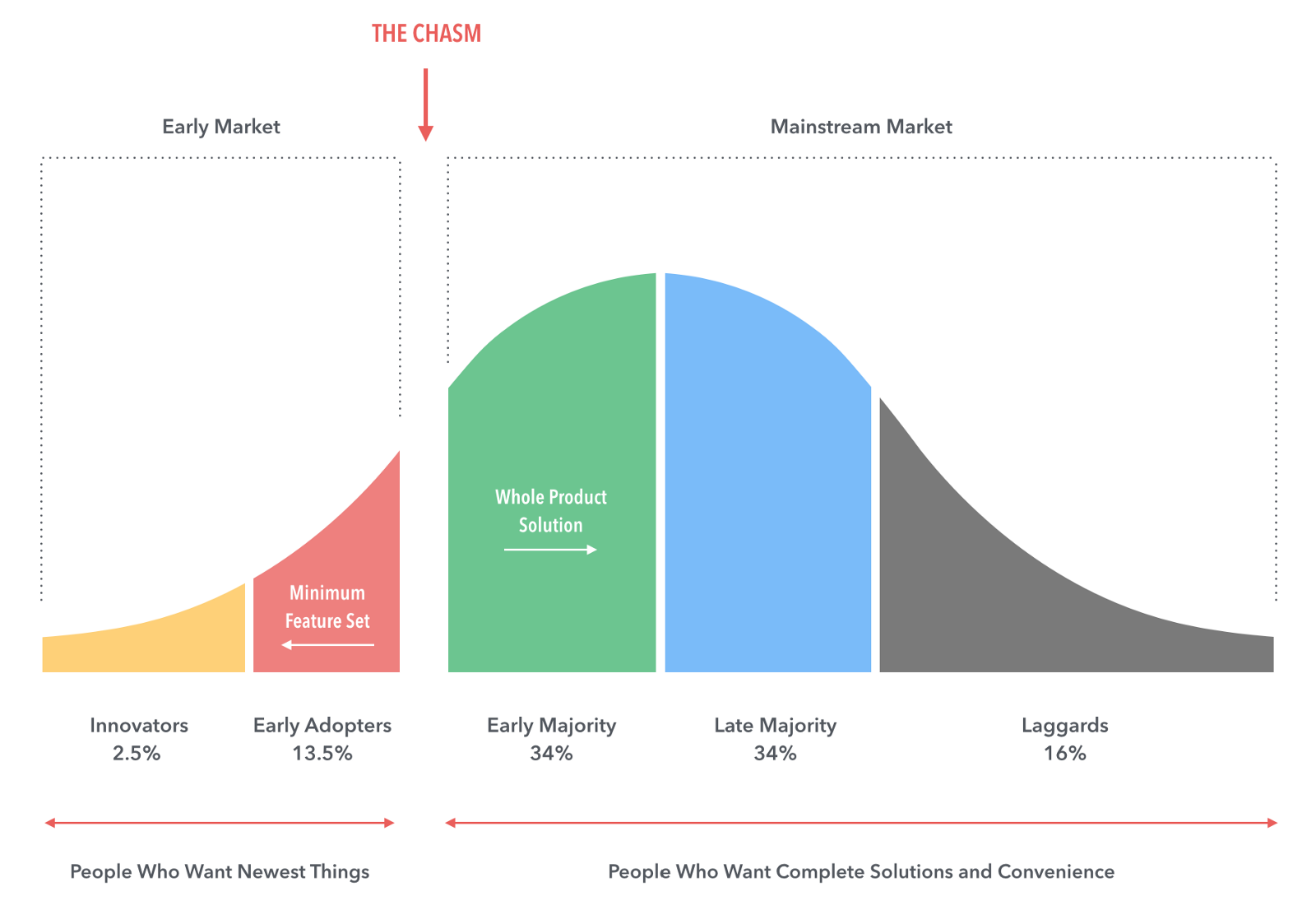
The mainstream market

crossing-the-chasm.png

The next group are the early majority, they are the key to getting a stable foothold on the market. This group are very loyal customers if you win them over and essential in securing growth and profitability. The next group are the late majority and are characterized by demanding easy to use, value-for-money products before anything else. Finally, the laggards, this group are the last to adopt an innovation. As clients they can be very tough to win and are therefore often ignored by many marketing efforts, yet can provide important feedback regarding the areas where your product could be further improved e.g. made even simpler, cheaper and more convenient to use.

The chasm is the point where the vastly different motivations for using the new product are emphasised. Visionaries seek out dramatic shifts in productivity which can enable them to quickly move forward, even despite resistance from within their own companies, the pragmatists want gradual, steady improvements, making sure no drastic changes occur too fast.


The early market

When trying to explain the Diffusion of Innovations theory to students, I always felt breaking it down to a simple analogy made it more palatable.


The first group are the innovators for whom owning the latest everything is a passion and an end in itself. The innovators proactively seek out new products to try them out, requiring almost no marketing efforts from your part. The next group are early adopters in search of competitive advantages provided by new products and services. The early adopters view technology as a means of achieving breakthroughs and aggressively gaining market edge.


The first two groups (the Innovators and Early Adopters) are visionaries. They want revolutionary change, something that sets them apart qualitatively from their competitors. They are the people who buy brand-new technology, before it’s been perfected or proved or before the price has come down. They usually have small companies and are willing to take enormous personal risks.

crossing-the-chasm.png

The two things that define us

patience.jpeg

A wise old man once told me that two things define us:
1. Your patience when you have nothing, and
2. Your attitude when you have everything.


My period of self-isolation ended last night and I am “officially” free to go outdoors. Now more than ever, I think it’s so important to tune in, look inward and listen to you intuition. It’s so easy to forget how to listen to that inner voice. This morning I took a moment to enjoy the silence and confirmed to myself how grateful I am to have come through B.1.351 (the South African variant) without any major symptoms.


Now we finally have an opportunity to focus on what matters most to us, make changes - and what better time to change your life than when it’s already changing?