The act of comparing

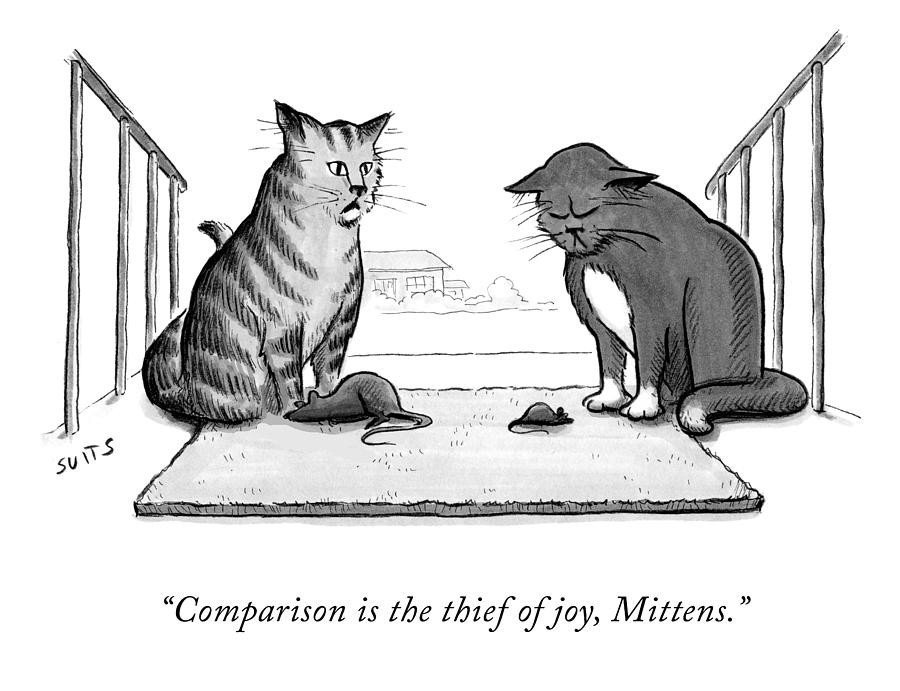
As humans, we are always comparing ourselves to each other and when we compare ourselves to others, we may be left with feelings of inferiority or superiority, I have always said comparisons are the theft of joy. Era comparisons are the most fruitless of conversations given the differences in variables on aspects such as science, tactics and even technology.

Comparison is the thief of joy.
— Theodore Roosevelt

Black Friday

Yesterday was Black Friday and it showed that retail stores are no longer just distribution points for products. Bricks and mortar spaces are powerful acquisition points for customers, and I think physical shops are the most powerful way to draw customers into the brands eco-system. Once acquired, shoppers can cross any number of channels elegantly woven with branded technology. Physical stores will a become media channel and media will become the store. I think the future will be where brands drive people towards media and stores will no longer be the end of the marketing funnels; they will be the beginning.


Hindsight is 20/20

Hindsight bias is when a person looks back at an event and believes they predicted the outcome, even if they failed to act on that "prediction." For example, on Saturday evening France will play a football match against Denmark, very fewer people are sure of the outcome of the game, but on Sunday morning, many more are willing to claim they were positive the winning team was indeed going to emerge the winner.

This is because we construct a situation where we fool ourselves into thinking we knew more about an event before it happened. The idea is that once we know the outcome, it’s much easier to construct a plausible explanation. Unfortunately, this leads us to think that our judgment is better than it is, and we become less critical of our decisions and makes us overconfident about future predictions.

Life can only be understood by looking backward; but it must be lived looking forward.
— Søren Kierkegaard

The generation effect

George Lois (RIP) was an advertising legend and he created one of my favourite adverts of all time and a masterpiece in strategic communication. The generation effect is a phenomenon where information is better remembered if it is generated from one's own mind rather than simply read. In 1985, Lois positioned the then unknown designer, Tommy Hilfiger on the map when he created a billboard with missing letters and placed it in Times Square. The billboard made Hilfiger a household name by placing his name in the same bracket as established greats like Ralph Lauren, Calvin Klein, and Perry Ellis.


Same same but different

When we find ourselves swimming in an ocean where everybody is trying to make similar content, the differences will be found in the intention of why people are making the content. And I think this is going to be the difference between why things work and why things don't work. The world is saturated with coaches, change your life books, do-gooders, etc., etc. The more successful we get the more of a test it is for the purity of the reasons why we create, and no one is exempt from that. We have to remain mindful and surround ourselves with people who tell you the truth, even though it can be hurtful, the truth is so important.


Act now

Strategic planning is the ongoing organisational process of using available knowledge to document a business's intended direction. This process is used to prioritise efforts, effectively allocate resources, align shareholders and employees, and ensure organisational goals are backed by data and sound reasoning. Goal setting is a purposeful and explicit process that starts with identifying a new objective, skill, or project you want to achieve. I think it’s important that you make a plan for achieving it, and you work to complete your goals. I am a skilled developer in strategic planning from conception to implementation. Contact me via e-mail for executive coaching and team assessments, as well as organisational assessments and strategic planning.


Things worth replacing

I am always looking for new ideas with energy and then finding good practical frameworks for transfer them from theories into action. Nowadays, I work at the intersection between theory and practice. Good theories must have problem solving power and I think the test of a new theory is its usefulness in practice.

Ability is what you’re capable of doing.

Motivation determines what you do.
Attitude determines how well you do it.
— Lou Holtz

Better questions

Good sales questions are measured by the level of curiosity they spark in your buyer. Buyers will create a budget where none exists when there’s a meaningful-enough problem, that’s worth solving.

  • Why do they need it?

  • How is it different?

  • Why is it better?

  • What happens if they don’t get it?

Knowledge is having the right answers. Intelligence is asking the right questions. Wisdom is knowing when to ask the right questions.
— Professor Richard Feynman

The power of leverage

I think leadership is not only about vision and setting strategy, leadership is also about building a team and nurturing their talent to enable them perform to the best of their abilities. The Centre for Creative Leadership think these are the ten traits of great leaders, in no specific order:

- Ability to delegate
- Ability to inspire
- Commitment
- Communication
- Confidence
- Creativity
- Honesty
- Intuition
- Positive attitude
- Sense of humour

Which one do you think is most important? Contact me via e-mail and let me have your thoughts.


Think about that

The majority of customers visit your website or your brick-and-mortar location only one time. All the marketing efforts and money that is spent on driving traffic to your business results in most customers only giving you one shot. And it can cost 5 times more to attract a new customer, than it does to retain an existing one. According to Bain & Company’s research, increasing customer retention rates by 5% increases profits by 25% to 95%. With these statistics in mind, it makes sense to focus efforts and funds to nurture your existing customers who are spending their money on your goods or services time and time again. This is not to say that you shouldn’t market to new consumers, which is a must, of course. But these statistics should be taken into consideration when budgeting how much you spend on acquiring new customers versus taking care of your existing customer base.


Look forward, not backwards

Each time you choose to trust yourself and take action, you can never quite be certain how the situation will turn out. Sometimes you are victorious, and sometimes you become disillusioned. Remember that there are no mistakes if you have learned something in the process. At the end of every day, ask yourself these three questions:

  • What did I learn today?

  • How did I grow today?

  • What will I do differently tomorrow?


Exploring the edges

Jamaica is a beautiful island located in the Caribbean. According to travel guides Jamaica famous for so many things, for example, reggae music, Bob Marley, Ursain Bolt, Blue Mountain coffee, rum, etc., etc. Both my parents are Jamaican and as I was born and raised in London, I have never explored the possibility of Jamaican nationality. It appears that so many professional footballers are in the same situation. There has been so much written in the media about the forthcoming FIFA World Cup in Qatar, so I thought I would change the narrative as I’m not sure whether to boycott or not. What about you, will you be watching?


Stories speak to emotions

We all know that there are two sides of the brain, the rational and the feelings/emotional side. In almost all kinds of decisions the emotional side of the brain is predominant, and stories speak to emotions. Nowadays when we are inundated with data and information it’s even more important that we focus on stories. You can speak about numbers, data and facts and leverage that in your storytelling, as the narrative helps us make sense of that data. I think that when we speak to people’s emotions it gathers and results in a higher response. Watch this video and see how changing the message will change the results.


Let's see what you've got

The further away a goal is in the future the less motivation it brings to today, they will have very little power today to govern our actions. If you don’t have a definition, at least get a direction by asking yourself the following questions:

1.          Why is the goal important to you?
2.          What will accomplishing that goal do for your life?
3.          What will happen if you do not accomplish this goal?


Reach out

Sales is the first thing you should focus on doing when you are starting out with your business. The key to successfully selling a product, service, or idea, is to ask questions and then listen quietly and carefully to the answers. Many of us try too hard to convince people to buy instead of discovering what our customer really wants, needs, and desires from us. The very best salespeople have a combination of the following:

1. Lead Generation
The finder introduces you to new markets. Finders are door openers and are really good at connecting with decision makers, bringing people together and networking.

2. Lead Conversion 

The closer follows scripts and is good at asking questions. The closer interacts with the people that the finder brought to them, makes the offer, and closes the deals.

3. Lead Retention 

The developer is the relationship builder who follows up with the clients after the sale has been made.

Reading the room


First, you read what you see - I mean reading body language. Salespersons soon learn that if the customer have their arms folded and chin tucked down with a frown on their face then this is going to take all your skills to get their arms unfolded and make them a little more comfortable. Crossed arms and legs are a clear signal that there is resistance to your ideas. Second, you’ve got the read what you hear. If it’s a two-way conversation you must listen as well as talk. We have two ears, one mouth, therefore, we should listen twice as much as we speak. Listen so that you know how to proceed and the best way to improve your listening skills is to practice "active listening." And finally, you have to pick up the emotional signals, for example, are you coming on too strong? How does your customer feel? etc.


I think reading the room is an art form; first what you see, then what you hear and finally what you feel. Speaking the same language as your customers is a subtle way to make them feel more welcomed. Contact me via e-mail for 1:1 session or to arrange a “reading the room” workshop for your team.


Do as you're told

Education and learning are not the same thing. Mass education was the ingenious machine constructed by industrialism to produce a constant flow of factory workers. Learning is the lifelong process of transforming information and experience into knowledge, skills, behaviours, and attitudes. Education is what we do for compliance and it’s about cohesion and you get a prize as a reward, that’s how they get you to do what you are supposed to do. I think that there are some educators who are also teachers and help with learning and there are also a lot of educators who are creators of an obedient system.

If you only read the books that everyone else is reading, you can only think what everyone else is thinking.
— Haruki Murakami

Fit for use

Is it worth more because it has my name on it?

Good quality does not mean luxury. Luxury means it’s expensive and you paid extra happily. In my opinion, luxury is a useful thing and there are a lot of luxury brands who do really well. On the other hand, quality means that this product or service meets the specifications and expectations, for example, what’s the difference between a Rolex and a Casio watch? Rolex is a luxury watch and if you can’t afford a Rolex, it may be a better quality to buy a Casio because it meets specifications and does what it says it does every single time. Making something of quality simply means did you define the specifications accurately and I think that we can all agree that that’s a requirement


Identify the decision

A mindset is like a fishing rod, it’s a way to maneuverer our lives to orientate ourselves towards success and good outcomes. The decision making process is making choices by identifying a decision, gathering information, and assessing alternative resolutions. Using a step-by-step decision-making process can help you make more deliberate, thoughtful decisions by organising relevant information and defining alternatives. I think that one of the biggest problems we are having in the world today is that people require simple answers to complicated questions. Therefore, it’s important not to make decisions today that you wouldn’t take again tomorrow.

An unexamined life is not worth living.
— Socrates

Perspective is everything

No one person can decide in big companies, there will always be a variety of stakeholders and different groups that must be involved. Our job as a consultant is to present inputs for them to build a business case and then highlight how we add value. I think one of the cornerstones of our success will be the ability to structure our business development process in a way that suits our customers needs. Where we are selling the pain that we are solving for them and then presenting it with numbers and results.

Imagination is more important than knowledge. For knowledge is limited to all we now know and understand, while imagination embraces the entire world, and all there ever will be to know and understand.
— Albert Einstein