

As you heal, you need to start forgiving yourself for all the times you let yourself stay in situations you weren’t valued but overstayed in order to prove your value. Trying to prove you’re valuable to people who reject you is a trauma response. Being alone at this time of year can be hard. Reach out to me via e-mail if you need help, I’m there if you need it.
Seasonal Greetings

“May your troubles be less and your blessings be more, and nothing but happiness comes through your door. Merry Christmas - Glædelig jul - Joyeux noël 🎄🎄. And for those of you who don’t celebrate Christmas, happy holidays.”
From the fringes

Image c/o The Guardian
Sometimes a pause gives purpose the opportunity to find you as when people have a vested interest it stops them from speaking the truth. Sustainability by using less becomes a tricky conversation as this goes completely against capitalism. Although we might not like the answer, and change is always uncomfortable, it’s tough to argue that there’s even a contest. Great design and a joined-up user experience matters more than ever in our lives today. I think by bringing design thinking to the core by understanding your customer strategy will help you position potential solutions. Contact me via e-mail for 1:1 sparring and coaching sessions in 2023.
Old fashioned and still relevant

I’m in London for the festive season and was thinking how much difference it would make if these three words - “Word of mouth” - were in most 2023 marketing plans. Word of mouth is the process of telling people you know about a particular product or service, usually because you think it is good and want to encourage them to try it. Word of mouth is the oldest form of marketing, and I think you will materially increase your revenue by incorporating these words into your marketing strategy.
““The best form of intelligence is not artificial” ”
Can you answer these three basic marketing questions?
1. Who are you talking to?
2. What do you do that no competitors can?
3. Why should we believe you?
Send me your answers via e-mail and win a one hour consultation with me.
Who am I to judge?

According to Medium truly intelligent people and are naturally curious. They can't get enough of learning; they chase knowledge and genuinely enjoy learning new skills. They often learn new things and new skills just out of curiosity, even when they know they don't need those skills for their career or for any other purpose.
Here’s my concise list of what smart people do:
1. Change their minds often
2. Use simple language
3. Admit when they are wrong
4. Ask for help when they are stuck
5. Ask better questions
6. Are self-aware
7. Are comfortable with uncertainty
8. Value soft skills
9. Talk less and say more
To improve is to change

c/o Getty Images
Knowledge does not come by naturally, you will have to go through a systematic training program as this is vital for ensuring a happy and successful life. In our everyday lives we can change and transform ourselves through training. I think that no matter what activity or practice we are pursuing, there isn’t anything that isn’t made easier through constant familiarity and training. Therefore, we should consider education as a very important factor for ensuring a successful and happy life.
“The world as we have created it is a process of our thinking. It cannot be changed without changing our thinking.”
Focus on one small goal

The concept of Zorro Circles is a metaphor for how we can follow our ambitions and achieve our goals by tackling the challenges we face one by one. Gradually, as we become ready, we can complete what we set out to do. I think the basic idea behind the Zorro Circle is that we should limit the scope of our efforts to a small area and as we gain resources, knowledge, and confidence, we expand our circle of control. And embarrassment is a powerful motivator for improvement and the more public the embarrassment, the greater the motivation.
Do you agree?

If you agree with the Greek philosopher, Aristotle, that all human action is purposeful in some way, and you are only truly happy when you are doing something that is moving you toward something that you want. The big questions then become:
· What are your goals?
· What purposes are you aiming at?
· What do you want at the end of the day?
This year I had the opportunity to work with a global financial services organisation, and they clarified their purpose as ‘enabling positive futures’. In other words, the better able they are to deliver financial services, the more likely they are to enable the positive futures of their customers. The key was that every employee in their organisation was conscious of this purpose and incorporated it into everything they did.
Smooth paths are seldom seen
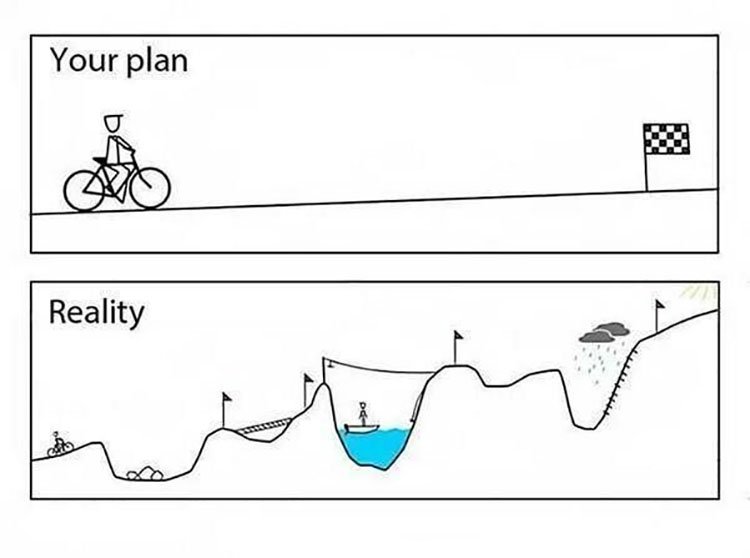
The key to success is to get clear on what you want, create a pragmatic plan to get it, and then execute daily on that plan without getting distracted. Goal setting and planning gives you the ability to put your blinders on, not look at what others are doing, stay in your lane, and keep executing towards your goals. Contact me via e-mail and let’s build an action plan to meet your goals together as the path between strategy and execution is seldom without challenges.
Focus on being

© Aleksandr Simonov
Mindfulness is based in Eastern philosophy, and has been describes as deliberately seeing what is in front of you, being fully present, and noticing what you’re doing, thinking and feeling in the moment. Mindfulness is gaining recognition as an approach to business and to risk management. From my perspective, meditation continually teaches me how to develop a different relationship to my thoughts and emotions. When my mind gets distracted by the commentary, I try to refocus on the being, in other words the present moment. Focusing on these micro moments are the key to mindfulness and has helped me reprogram my stress response. More present, more aware, less wound-up, less reactive and this has a huge effect on how I deal with situations around me.
“The older you get, the more quiet you become. Life humbles you so deeply as you age. You realise how much nonsense you’ve wasted time on.”
A chain of steps

Utopia is often referred to as a good place that doesn’t exist. There are two things that trigger the buying decision process:
a) Moving away from pain, or
b) Moving towards pleasure
I think everything that we do, everything that we buy, every decision that we make in buying anything is driven entirely by how we feel now and how the purchase will make us feel. The buying side decision process goes through five stages:
1. Realisation that we have a problem (recognition)
2. Look for alternatives (search)
3. Quantify what it may do for us (evaluation)
4. And then start to engage (purchase)
5. After sale (post-purchase)
“If you cannot explain something in simple terms, you don’t understand it. The best way to learn is to teach. ”
Leading a winning team

Tom Landry correctly described a heroic leader as someone “who tells you what you don't want to hear, who has you see what you don't want to see, so you can be who you have always known you could be.” Leading is the pinnacle of human achievement. Your task and number one priority is to help others grow, develop, and contribute to their colleagues and communities. I think your accomplishment list will be measured by those who went on to be wildly successful in large measure because of time spent with you.
Athletes of the business world

In the future we will need people who can connect and communicate. And we will need people to transfer confidence, emotion, and a positive view of the world. We don’t need people to send e-mails as anyone including robots can send e-mails to promote products and services. I think salespersons are the athletes of the business world as they intrinsically enjoy competition. Successful salespeople are goal-oriented and self-motivated and these are also defining qualities of high-performing athletes.
Utopia doesn't exist

“With great power comes great responsibility” has a simple meaning; if you have the ability to do something, make sure that you do it for the good of others. As a consultant we earn our keep one hour at a time, therefore, one has to adjust your process and style to how your customers need to be communicated with. Most organisations today think in quarterly and annual forecasts, therefore, when you sign a consultancy contract, the launch may not necessarily be immediate.
“What I hear, I forget;
What I see, I remember; and
What I do, I understand.
”
Our beliefs and opinions

Perception refers to our sensory experience of the world, in other words, perception is based on our viewpoint, experience, and behaviours from where we stand, and sometimes that isn’t always accurate. How we see things around us, no matter how they actually are, become what's real to us and our perception of reality is limited by our five senses; touch, sight, sound, smell, and taste. And it is through this experience that we gain information about the environment around us, and I think this shapes our beliefs and opinions.
Somebody's opinion

There will always be two types of people; those who become accustomed and accept the system, and those who will always fight for the truth. And my life experience has taught me is that truth is highly subjective. There may be an objective truth and we humans can't know it because we are condemned to the bias of our own experiences, biases, and preferences. As professional marketers we all believe that we make decisions rationally, but we are as likely as anyone to be influenced by external biases. And social proof has consistently been shown to be one of the most powerful behavioural biases.
“The ultimate measure of a man is not where he stands in moments of comfort and convenience, but where he stands at times of challenge and controversy. ”
The complexity of listening

Joseph DeVito in his book, “Essentials of Human Communication” divided the listening process into five stages: receiving, understanding, remembering, evaluating and feedback. I think by becoming aware of what is involved with active listening and where difficulties might lie, you can prepare yourself both as a listener and as a speaker to minimise listening errors with your own public speeches. Contact me via e-mail and let me know whether you are aware of the verbal and nonverbal ways of indicating your appreciation for or your disagreement with the messages or the speakers at the end of the message.
“Your style introduces you before you even speak.”
Risking your reputation

Many brands are built on a single belief that "claims" superiority in a crowded marketplace. Managing expectations is the practice of communicating information to prevent gaps between stakeholder perceptions and business realities. The theory of strategic narrative are tools that actors employ to promote their interests, values, and aspirations. Inaccurate stakeholder assumptions can result in failures and perceptions of failure. When working with brands I think strategic narratives should define "who we are" and "what kind of world order we want."
“You have to willingly give and graciously receive, and if you have to think before you give then you are trading.”
Just imagine

Why can’t we just train people to become curious and thirsty for knowledge? We can! And if we do this the number of other things, they can learn is unbelievable. We have seen that bit by bit on the internet there is a body of work that lets the employer know you’re worth hiring now. We are going see more and more free stuff and more and more expensive stuff. Just imagine if there was a portfolio system where you are hired and fired on the basis of your work. Just imagine if there is this type of relationship in place where people who know you and trust you also hire you. The education system of the future or should I say, the hiring of people in the future will look less like where you went to school and more and more what have you built, who did you work for and what would they say about you.
Don't say it

Leadership is about inspiring others to believe and enabling that belief to become reality. Inviting dissenting views and amplifying quiet voices are acts of leadership. The true leader in a group is rarely the person who talks the most, it's usually the person who listens best. Listening is more than hearing what’s said, and I think it’s also noticing and surfacing what isn’t said as communication doesn't only happen verbally.