

When you are born and raised within a culture where people look alike on the surface, in a homogeneous environment, how do you react when you meet people who don’t look like you? Is there really a causal relationship between having some surface level differences in a group and the ability of the group to actually benefit from the different perspectives and ideas that they have? Not everybody in the group knows the same information or have had the same experiences, values or background as yourself. It's been proven over and over again that diverse groups outperform homogeneous groups. Diverse groups are more likely to share their unique information and perspectives that they have in their heads when they see that there’s some surface level differences amongst them.
Think differently

We use social characteristics to determine who is similar to us and who’s different from us. What are their values? What are their perspectives? What are their experiences? What is it they bring to the table? There are surface level differences and deeper differences, and due to our biases, we use what we see on the surface to make predictions about people. To make predictions about what they think and how they feel. Diversity is also about what people actually think.
Self talk is crucial

Paradigms can be thought of as mental programs that largely dictate our habitual behaviour, as most of our actions are driven by habits. Our brains constantly seek validation for our beliefs, a phenomenon known as confirmation bias. For instance, if you believe "nothing ever goes my way," your brain will highlight everything that confirms that belief. On the other hand, if you tell yourself, "I know things can get better," your brain will begin to find evidence to support this idea. Your mind is simply performing its function by actively searching for proof to reinforce the reality you've constructed in your thoughts. Therefore, I think it's crucial to remember that you have the power to influence the world around you through your mindset.
The watered down version of DEI

I recently used an anology to illustrate the concepts of Diversity, Equity, and Inclusion (DEI) in the context of a meeting.
Diversity - Who is invited to the meeting?
Equity - Who is trying to get in but can’t?
Inclusion - Has everyone’s views been heard and acknowledged?
The receiver thought it captured the essence of each component of DEI, making it easy to understand and apply. What do you think?
““You can’t access empathy if you’re not willing to be vulnerable.””
The "D" in DEI

Diversity is not about conforming to the norm established by the dominant group; it's about recognising and valuing the variety of experiences that individuals bring to an organisation. I think that organisations are only truly diverse when they embrace and leverage the unique backgrounds, perspectives, and experiences of their members. I view diversity as the collective mosaic of these diverse experiences, which enriches the fabric of any organisation or community. By appreciating and integrating these varied experiences, organisations can foster a more inclusive and dynamic environment. Contact me via email for a deeper dive into your organisations DEI maturity levels.
A new paradigm

The workplace is now more age-diverse than ever, with five generations - Boomers, Generation X, Millennials, Generation Z, and Alpha - working side by side. This age diversity among employees can be both a blessing and a challenge. Young people entering the workplace bring a different mindset and language, and they openly discuss their needs. In Denmark, 50% of Generation Z identify as neurodivergent, necessitating structural changes in society, including how educational institutions are run and how people work. And I think that leadership development training should focus more on emotional intelligence rather than just technical skills.
Saying it as it is
I am not ashamed to admit that watching this video was the most insightful thing I have done today. We DEI professional think we know, this 10 minutes of productive self-awareness may question your biases.
Why diversity benefits everyone

Are we taking advantage of the diversity that we have?
From my own life experiences, I have learned how we can take advantage of the diversity around us. I think about diversity very broadly, encompassing both social categories and personal characteristics. Social categories include factors such as religion, race, gender, ethnicity, sexual orientation, and age. Personal characteristics include functional roles within an organisation, such as marketing or finance, as well as seniority, such as who joined the organisation under which CEO.
We often use these differences to make predictions about people - a cognitive process where we determine who is similar to us and who is different. Diversity also involves understanding people's values, perspectives, and experiences, the deeper aspects they bring to the table. There are surface level differences and deeper differences, and due to our biases, we use what we see on the surface to make predictions about people, and to make predictions about what they think and how they feel.
Facts on Friday

What can you do to help?
DEI in the workplace and what it really means is a constantly evolving topic that you can’t learn from a book. I think both the personal and legal insights is what truly matters when trying to understand the position of underrepresented groups in the workplace through listening to their first-hand experiences. I have been guiding HR teams about the pressing issues they face and the right language to use when referring to a particular issue. When you don’t know what it’s like first hand to be part of an underrepresented group in the workplace then it’s worth taking time to understand how you can gain this insight. #justsaying
Fragility matters

How does fragility show up in the DEI space?
There is a notable presence of gatekeeping by privileged individuals who dominate discussions and initiatives in the DEI space in Denmark. These individuals often control the narrative and access to DEI resources, driven by a fear of losing power to those who might possess more knowledge or different perspectives. This defensiveness manifests as fragility, where they react negatively to criticism or conversations highlighting systemic inequalities. I think that telling uncomfortable truths can cost you friends, especially when you speak about the extraction of minerals and precious metals from Africa whilst the indigenous people live in poverty.
Free from biases

Diversity, equity and inclusion (DEI) is not only about skin colour; it’s about giving people who have talent the opportunity to express that talent. Often, the starting point can be biased, leading those who are not white to question:
a) Whether they possess the required skills, and
b) If they are the best person for the job.
I advocate for DEI policies because I recognise that many talented individuals from minority backgrounds deserve the same opportunities as the majority. In practice, minorities often need to be exceptional to secure white-collar jobs because societal structures have historically disadvantaged them. I think the western world was built on a patriarchal framework by the white majority, and it was not originally designed to include minorities.
Closely linked values

What does inclusion of diversity mean to you?
I think emphasising the importance of inclusion is the key to unlocking the value of diversity. Inclusion allows the unique perspectives, experiences, and backgrounds that your employees bring to truly contribute to your organisation’s ability to innovate, challenge assumptions, and identify risks. By fostering an inclusive environment, you will ensure that employees feel safe and secure to speak up and share their ideas, enabling them to fully participate and contribute to the organisation's success.
Belonging at work

DEI in the workplace and what it really means is a constantly evolving topic that you can’t learn from a book. I think both the personal and legal insights is what matters when trying to truly understand the position of underrepresented groups in the workplace through listening to their first-hand experiences. I have been guiding HR teams about the pressing issues they face and the right language to use when referring to a particular issue. When you don’t know what it’s like first hand to be part of an underrepresented group in the workplace then it’s worth taking time to understand how you can gain this insight.
Listen to your employees

One of the most important things I have learned about Diversity, Equity, and Inclusion is the importance of active listening to your employees. And by doing so, you will gain insights that will identify your organisational challenges. Which subsequently will allow you to target your focus areas and tailor your approach to effectively maximising your impact. I think connecting with others is key, as we are all facing similar challenges.
It's just a discussion
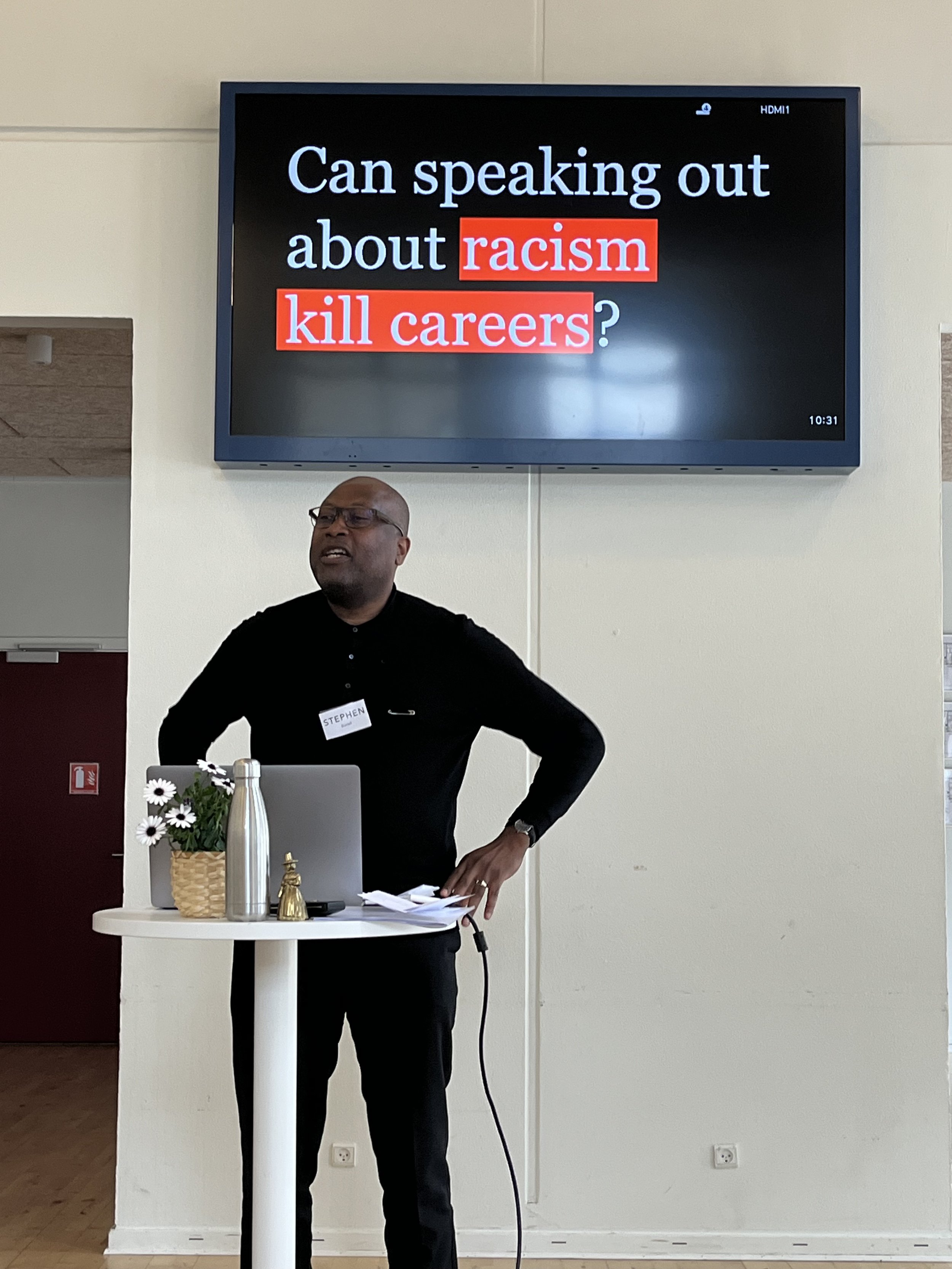
If everyone is agreeing with you then you are in an echo chamber and you have just chosen the people to speak to. Controversy is just saying something that someone else just doesn’t agree with. I’m never afraid to speak about any subject that I have knowledge about as I only say things that I believe is fair.
You can book me for workshops, keynote speaking, coaching, DEI trainings or implementation facilitation here.
A pregnancy story

Allyson Felix is the most decorated female track and field athlete in Olympic history, a true great of the sport. Allyson Felix’s Nike contract expired in December 2017, when Felix became pregnant in 2018, Nike asked her to reduce the terms of her contract and take a 70% pay cut, and allegedly they told her to “know your place and run.” Amid all of this, she was forced to have an emergency c-section seven months into her pregnancy because of a potentially life-threatening condition, and her baby had to live for more than a month in the neonatal intensive care unit. Nike and Allyson Felix parted ways in 2019, and created her own brand of running shoes - Saysh One. In 2020, Allyson Felix qualified for her fifth Olympics in Japan wearing her own shoes under the banner “I Know My Place.”
After a broad public outcry and a congressional inquiry, Nike announced a new maternity policy for all sponsored athletes. The new contract guarantees an athlete’s pay and bonuses for 18 months around pregnancy. Subsequently, three other major athletic brands added maternity protections for sponsored athletes.
““Everyone sees the glory moments, but they don’t see what happens behind the scenes.””
Active allyship

Allyship needs to start with an examination of self, to better understand the power, privilege, and access available to you as an individual, as a result of the different identity groups to which you belong. Being an ally also requires deep education about the communities that you’re interested in demonstrating allyship toward. In Denmark, there is a disconnect between how minorities and majority cultures define allyship. The majority culture in Denmark think the most meaningful action they can take is to speak out about gender discrimination, whereas minorities think the best thing an ally can do is advocate for new opportunities. I think that cultural understanding and empathy are crucial for effective allyship efforts in order to have a more inclusive and collaborative approach to addressing issues of inequality and discrimination.
Why is this so difficult?

Intersectionality was coined in 1989 by professor Kimberlé Crenshaw to describe how race, class, gender, and other individual characteristics “intersect” with one another and overlap. For example, I am both Black and a man, so the lived experiences of discrimination from my perspective as a Black man is different from those of a Black woman or a white man’s.
““Intersectionality is a metaphor for understanding the ways that multiple forms of inequality or disadvantage sometimes compound themselves and create obstacles that often are not understood among conventional ways of thinking.””
The overlap

In recent months, our focus has been on exploring how a deep understanding of intersectionality can enhance the sense of belonging in the Danish workplace. We've developed a comprehensive framework that emphasises the difference between equality and equity, and we've introduced an identity wheel as a tool to actively support marginalised groups. Our next step is to finalise the framework and begin testing it within focused groups comprising leaders and managers. Our ultimate goal is to enhance decision-making processes and foster more meaningful interpersonal connections.
Speaking about it with humour

The American comedian, Andrew Schulz performs in front of audiences who are completely mixed in every sense, they are properly represented and diverse. Schulz solves the diversity problem in a rather interesting way, not by pretending that touchy subjects like race or gender don't exist but by highlighting the distinctions and taking the "mickey" out of them. Perhaps from a creative point of view this is a better way to incorporate the diversity with humour rather than being politically correct and skipping around the topics. Do you pretend to make people not notice ethnic differences? Are you anxious in the presence of any of those differences, or do you acknowledge them and make light of them?